
Coal, crude oil, natural gas, refinery products, fertiliser, steel, cement and comprise 40.27 per cent of the weight of items included in the Index of Industrial Production.

'At this stage, you should distribute money and food.' 'Like you queue up to vote, let people queue up to collect this.' 'This will arrest the decline in demand which will have a multiplier effect on the demand side for the economy as a whole.' 'The government should earmark about 2% of the GDP for this.' 'And this should be the first step to revive the economy.'

IIP's contraction deals a severe blow to the Indian economy.
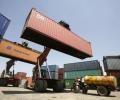
UN economists announced a likely USD 50 billion drop in the worldwide manufacturing exports in February alone as the extent of the damage to the global economy caused by the novel coronavirus (COVID-19) moved further into focus. Citing the China Manufacturing Purchasing Manager's Index (PMI), Pamela Coke-Hamilton, who heads UNCTAD's Division on International Trade and Commodities, said that it had fallen to 37.5 -- a drop of about 20 points -- the lowest reading since 2004. "This also correlates directly to exports and also implies a two per cent drop in overall exports," she said, with a resulting "ripple effect" worldwide "to the tune of a USD 50 billion fall in exports."

According to a statement available on the Ministry of Statistics and Programme Implementation website, gross domestic product, consumer price index and index of industrial production will now be released at 5.30 in the evening.
Business activity contracted in Q2 FY20, the first contraction since 2013-14 and the second since the 2008 global financial crisis, report, Abhishek Waghmare and Anup Roy.
Signs of "green shoots" in India came in the form of an ABN-Amro Bank purchasing managers' index based on a survey of 500 companies.

Poor quality of education is one of the most important reasons for high unemployment in India, says Kavita Nigam.
Weakness seen in software shares, auto stocks gain on good sales growth.

Buoyed by healthy farm output and narrowing current account deficit, India is the seventh most economically confident country in the world, a study by global research firm Ipsos has said.

The Nikkei India Services Purchasing Managers' Index, which tracks services sector companies on a monthly basis, stood at 52 in September, down from August's 43-month high of 54.7, pointing to a slower and moderate rate of expansion.

The HSBC/Markit purchasing managers index for the services industry inched up to 47.1 in October from 44.6 in September, the fourth successive monthly contraction of service sector output across India.

Top companies across sectors -- automobile maker Maruti Suzuki, consumer electronics giant Samsung to IT giant Infosys -- have reopened factories and offices as India took its first steps towards resuming economic activity after weeks under a near-total coronavirus lockdown.

The total vehicle registrations in India fell by 29.85 per cent to 1,52,71,519 units in financial year 2020-21, the lowest in the last eight years, the Federation of Automobile Dealers Associations (FADA) said on Monday. Total vehicle registrations were at 2,17,68,502 units in fiscal year 2019-20. All categories of vehicles, except tractors were in red in FY21 with two-wheeler (2W), three-wheeler (3W), commercial vehicles (CV) and passenger vehicles (PV) falling by 31.51 per cent, 64.12 per cent, 49.05 per cent and 13.96 per cent respectively -- the lowest in last eight years and way below the FY13 levels, FADA said in a statement.
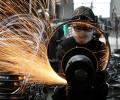
As Covid-19 cases surge in India, companies have realised it's a tightrope walk between maintaining production and ensuring employee safety.

a list of top five powerbanks that strike a perfect balance between price, portability and capacity
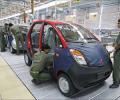
Expressing disappointment over the contraction in industrial growth in October, India Inc has appealed to the Reserve Bank to cut interest rates to revive the manufacturing sector and ameliorate investments.

Beside manufacturing, deceleration was also witnessed in sectors like agriculture, construction and electricity, gas and water supply.

Industrial output rose to nearly three-year high of 6.4% in August.

In the next six months it will be subdued.

Industry officials say the crunch has not only affected manufacturing of edibles but even of items like nozzle pumps and other goods used in packaging.

Out of 30 key export sectors, as many as 22 showed negative growth in September.
The RBI left interest rates unchanged, saying there was no substantial development on inflation or fiscal fronts to warrant a fresh reduction.
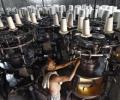
India must concentrate on manufacturing-led growth.

Top companies reported that despite most of them making staples and essential products, movement of raw material, goods and labour remained restricted, impacting sales.
Fiat was founded in 1899 by a group of investors including Giovanni Agnelli. Besides automobiles, Fiat has also manufactured railway engines and carriages, military vehicles, and aircraft during its century long history.
Fiat was founded in 1899 by a group of investors including Giovanni Agnelli. Besides automobiles, Fiat has also manufactured railway engines and carriages, military vehicles, and aircraft during its century long history.
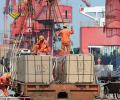
Import segments which recorded negative growth include gold, silver, transport equipment, coal, fertiliser, machinery and machine tools. However, exports of oil seeds, coffee, rice, tobacco, spices, pharma, and chemicals reported positive growth in June.

Believes India can grow at 6 - 7 per cent next fiscal.

A digital configurator comprising a three-dimensional graphics-based app will allow customers to choose specifications and align the output generated by the tool to company's back-end manufacturing.

High lending rates, fuel prices, higher input costs and labour trouble impact profitability.

According to Japanese financial services major Nomura, despite slowing external demand, the domestic growth cycle is improving.

Winning against Covid means thinking ahead, at least six months, putting in place the likely scenarios of what might happen, and then planning. Planning is the role of the government. Having planned, it should communicate what and why. Then, get out of the way, recommends Naushad Forbes.

After unseasonal rains, supply disruptions and pandemic-induced woes pushed retail inflation well over the Reserve Bank's comfort zone in 2020, the scenario is likely to stay that way at least in the short term as economic recovery slowly gains foothold. For most part of this year, pricier food items pushed the retail inflation, based on Consumer Price Index (CPI), higher in the range of 6.58-7.61 per cent, except for March when the reading was 5.91 per cent. Experts believe retail inflation is likely to average around 6.3 per cent this fiscal and mostly will remain sticky going forward owing to pick-up in demand across sectors.

On the impact of declining industrial production on economic growth, he said "the growth rate for the current fiscal will be between 5.5 per cent or 6 per cent. Perhaps 5.7 per cent is the likelihood".

HDFC, L&T, Hind Unilever, ICICI Bank among top Sensex losers

In the broader market, the S&P BSE Midcap and the S&P BSE Smallcap indices added 0.6% and 1.3%, respectively to touch their fresh lifetime highs.
Rising interest cost led to drastic deceleration in manufacturing growth to 3.9 per cent in May, compared to 11.3 per cent in a year-ago period. Manufacturing has a weight of over 79 per cent in IIP.
.jpg)
According to industry body Society of Indian Automobile Manufacturers and Automotive Component Manufacturers Association of India, with demand continuing to be low and factories not operating at full scale, this may lead to temporary excess overheads.
